Hiring a Plumber in Ireland: What to Check Before You Book
A practical checklist for Irish homeowners on how to find a reliable, qualified plumber. Covers RGI registration, insurance, quotes, and red flags to watch for.
Emergency Plumber Athlone
15 September 2025
We know that sinking feeling when the boiler cuts out on a freezing January night. It is a stressful situation that requires fast action. This is exactly why Hiring a Plumber in Ireland: What to Check Before You Book is a subject we cover with every client.
You need someone qualified to fix the problem permanently. We want to share exactly what separates true professionals from the rest.
The wrong choice can cost thousands in water damage or illegal gas work fines.
Let us walk through the essential checks to make before booking a tradesperson. This guide covers the specific credentials to verify, the red flags to spot, and the exact questions to ask to protect your home.
1. Check for RGI Registration
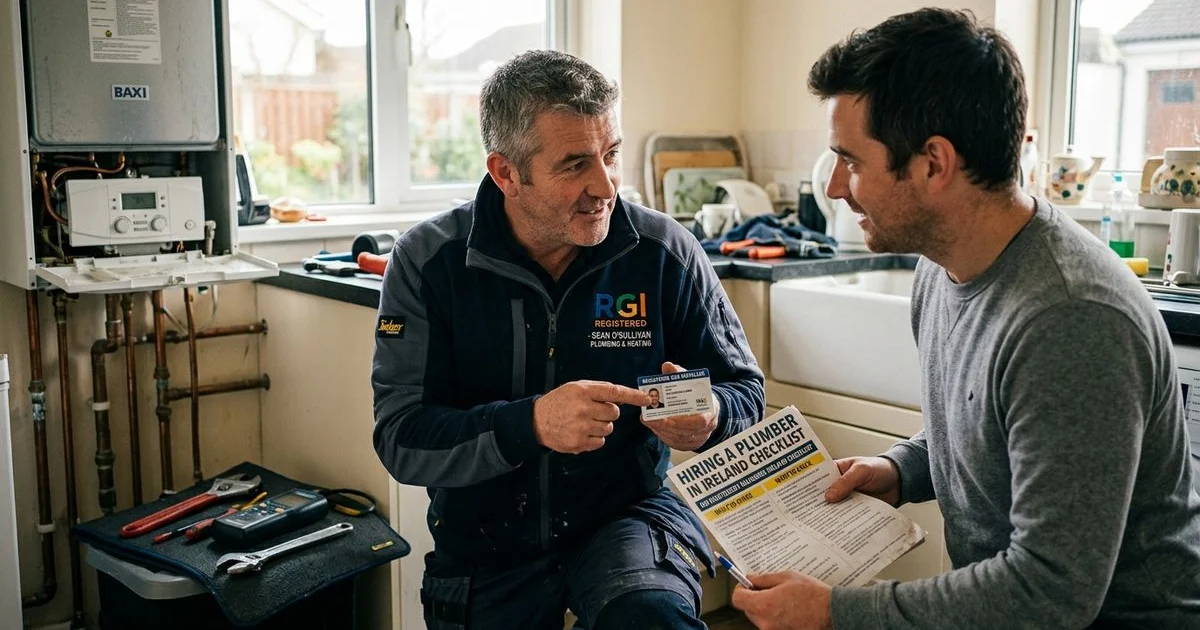
We consider this the most critical check for any homeowner in Ireland. RGI stands for Registered Gas Installer. Our team cannot stress enough that this is a strict legal requirement for anyone working on gas appliances, including boilers, fires, and hobs.
The Commission for Regulation of Utilities (CRU) maintains this essential register. Only professionals who pass rigorous assessments join the 3,000 registered installers currently operating across the country.
Why Legal Compliance Matters
Hiring an unregistered person is a criminal offence. Illegal gas work frequently results in carbon monoxide leaks or severe explosions. We have seen homeowners face voided insurance policies after using uncertified workers.
The CRU regularly prosecutes fake installers. Fines for illegal gas work can reach up to €15,000, and recent 2025 court cases even resulted in suspended prison sentences.
How to Verify Credentials
You can check a professional’s status quickly. Visit the official website at www.rgii.ie to search for their specific name or business. Every certified installer carries a valid ID card bearing a unique number.
A legitimate tradesperson will gladly show you this card. Treat any hesitation or evasive answers as a massive red flag.
When RGI Is Not Required
Gas registration is only mandatory for gas-related tasks. You do not need an RGI professional for basic water tasks like fixing a leaking tap, installing a toilet, or fitting a shower pump.
Choosing an RGI-registered company for general plumbing still provides great peace of mind. It proves the contractor meets high professional standards and answers to a strict regulatory body.
2. Verify Their Insurance
We always carry full insurance documentation in our vehicles. A single burst pipe can easily cause upwards of €5,000 in water damage to Irish homes. Our industry sees these expensive accidents happen regularly.
Public Liability and Employer Cover
Any reputable contractor holds public liability insurance. This policy covers accidental damage to your property, like a dropped tool cracking your expensive floor tiles. Standard policies from providers like FBD or AXA usually cover a minimum of €1.3 million, with many extending to €2.6 million.
Employer’s liability insurance is another legal requirement if the contractor uses subcontractors. Sole traders often carry this too for added safety.
Do not hesitate to ask for proof of these policies. A genuine professional respects a thorough homeowner.
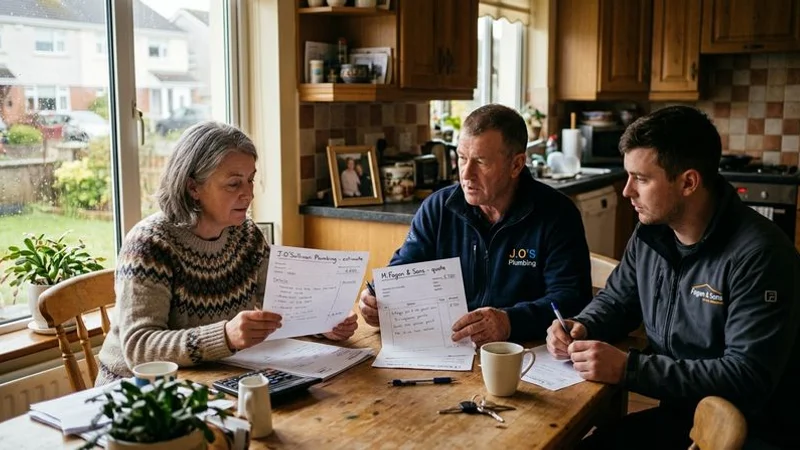
3. Get a Written Quote, Not Just an Estimate
We provide fixed written quotes because verbal estimates cause too many arguments. An estimate is merely a rough guess that often changes. A quote guarantees a specific price for a clearly defined job.
Always demand a written document for your records. The breakdown should clearly separate labour, materials, and expected payment timelines.
In Ireland, the reduced VAT rate for building and plumbing repair services sits at 13.5%, so ensure this is calculated correctly. Note that heat pump installations dropped to a 9% VAT rate in January 2025.
| Feature | Written Quote | Verbal Estimate |
|---|---|---|
| Price Certainty | Fixed price | Subject to change |
| Legal Standing | Binding agreement | Rough guide only |
| Detail Level | Itemised materials and labour | Broad overall figure |
A verbal agreement might suffice for minor tap repairs or toilet fixes. You should always secure a written contract for major jobs like a boiler installation or a full heating system upgrade.
The Importance of Multiple Quotes
We advise getting three quotes for any job exceeding €500. Average hourly rates for plumbers in Ireland currently range between €80 and €120. Comparing prices helps you spot anyone charging wildly above or below the market average.
Extremely cheap quotes usually signal poor materials or hidden incoming charges.
4. Ask About Experience and Specialisations
Our trade covers a massive variety of highly technical skills. Some contractors focus purely on drainage, while others spend their days installing complex heating systems. It pays to hire someone familiar with your exact problem.
Targeted Questions to Ask
You need to verify their specific track record. Ask these direct questions:
- How many years have you traded locally?
- Do you hold specific certifications for this brand of boiler?
- Can I speak to a recent customer who had similar work done?
- Are you registered with the SEAI for grant-funded work?
A technician with 15 years of experience fitting Worcester Bosch units is your best bet for a boiler installation. If you want a heat pump installed, the contractor must be specifically registered on the SEAI installer list for you to claim any government grants.
5. Check Reviews and References
We know that a strong local reputation is a tradesperson’s most valuable asset. Online reviews provide a great starting point, but you must read them critically. A profile with fifty reviews averaging 4.5 stars is far more reliable than a flawless 5.0 score based on three suspicious comments.
Where to Find Honest Feedback
Start your research on Google Business Profiles. This platform usually offers the most unvarnished look at a company’s reliability. Local Facebook community groups also provide excellent word-of-mouth recommendations from neighbours.
Dedicated trade sites like Tradesmen.ie are another solid option for verifying credentials.
Spotting the Warning Signs
You should watch for specific behavioural patterns in the feedback. Consistent complaints about missed appointments or messy workspaces indicate a lack of respect. Pay close attention to how the business owner replies to criticism.
Aggressive or dismissive responses to unhappy customers show a lack of professionalism.
6. Clarify the Scope and Timeline
We always map out the exact sequence of events before lifting a spanner. Misunderstandings regarding the scope of work cause most disputes between homeowners and contractors. You must define every boundary of the project clearly.
A standard bathroom refit typically takes 5 to 7 working days to complete. Does your quote include taking the old tiles to the recycling centre, or is rubbish removal your responsibility? You must also confirm if the price covers repairing holes made in plasterboard.
Establish a realistic schedule immediately. Plaster and silicone sealant need 24 to 48 hours to cure properly before you can use the shower.
7. Understand the Payment Terms
Our industry follows standard payment structures that protect both parties. Construction Industry Federation (CIF) guidelines generally discourage paying for everything upfront. You should agree on a clear payment schedule before work commences.
Standard Payment Guidelines
These are the typical payment expectations for Irish tradespeople:
- Small tasks (under €200): You pay the full amount upon completion.
- Medium jobs (€200 to €1,000): Settle the invoice upon completion or within 7 days.
- Large projects (over €1,000): A 30% deposit is standard practice to secure expensive materials like boiler units.
A demand for 100% cash upfront is a massive warning sign. Legitimate professionals provide proper VAT invoices and accept traceable payment methods like bank transfers.
8. Ask About Guarantees
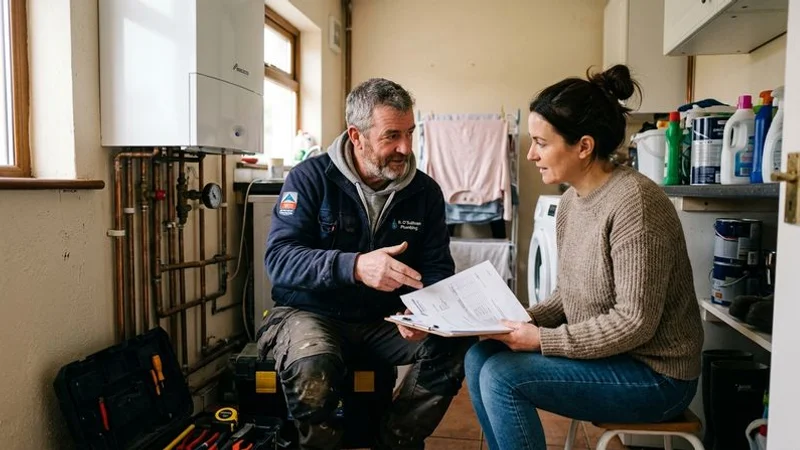
We stand by the quality of our installations long after we leave your property. A confident professional willingly provides guarantees for both their labour and the supplied parts. You need protection against faulty materials or poor workmanship.
Labour and Manufacturer Warranties
Most established companies offer a standard 12-month guarantee on their manual labour. Manufacturer warranties for the actual components operate separately. Leading brands like Grant or Worcester Bosch often provide warranties stretching up to 10 or 12 years.
These long warranties are strictly conditional. You only get that 10-year cover if an accredited installer fits the boiler and services it annually.
9. Check Their Availability for Emergencies
We receive panic calls every weekend from people whose regular contractor will not answer the phone. You want a relationship with a company that handles after-hours disasters. A burst pipe or a severely blocked drain cannot wait until Monday morning.
Ask your contractor about their out-of-hours response times and specific pricing. Emergency plumbing call-out fees in Ireland currently average between €135 and €165. A transparent professional will tell you exactly what that fee covers.
You need to know if that initial charge includes the first hour of labour or just the arrival fee.
10. Trust Your Instincts
Our reputation relies heavily on basic courtesy and clear communication. A tradesperson’s attitude during the quoting process tells you exactly how they will behave during the job. You should feel comfortable asking questions about your own home.
Look for simple signs of professional respect. Do they wear a uniform, drive a sign-written van, or carry a Safe Pass card? A good tradesperson explains the problem without relying on confusing jargon.
If they fail to return your initial calls promptly, they will likely ignore you if a leak develops later.
Your Checklist for Hiring a Plumber in Ireland: What to Check Before You Book
We highly recommend using this checklist before handing over any money.
- Verified RGI registration on rgii.ie (mandatory for gas)
- Confirmed public liability insurance cover
- Secured a written quote with a 13.5% VAT breakdown
- Checked specific SEAI or brand qualifications
- Read recent reviews on Google Business or Tradesmen.ie
- Agreed on a clear schedule and rubbish removal
- Refused to pay 100% upfront
- Confirmed the 12-month workmanship guarantee
- Asked about the €135-€165 emergency call-out terms
Looking for a Reliable Plumber in the Midlands?
At Emergency Plumber Athlone, we tick every single box on this critical checklist. Our professional service team is RGI registered, fully insured, and has served the midlands since 2015. You now understand Hiring a Plumber in Ireland: What to Check Before You Book.
We provide clear written quotes without hidden charges, guaranteeing peace of mind on every job. You can count on our experienced technicians for an emergency repair, a routine boiler service, a complex heating upgrade, or a complete plumbing installation.
Call us on 090-664 1014 to discuss your specific requirements. We gladly provide free advice and site visits.
Emergency Plumber Athlone
Plumbing & Heating Engineers
The team at Emergency Plumber Athlone have been providing dependable plumbing and heating services across County Westmeath, Roscommon, and East Galway since 2015. RGI registered and fully insured.
RGI Registered Gas Installer